
Charles Ponzi didn’t invent the Ponzi scheme. He just did it so spectacularly that we named it after him.
Boston. July 1920.
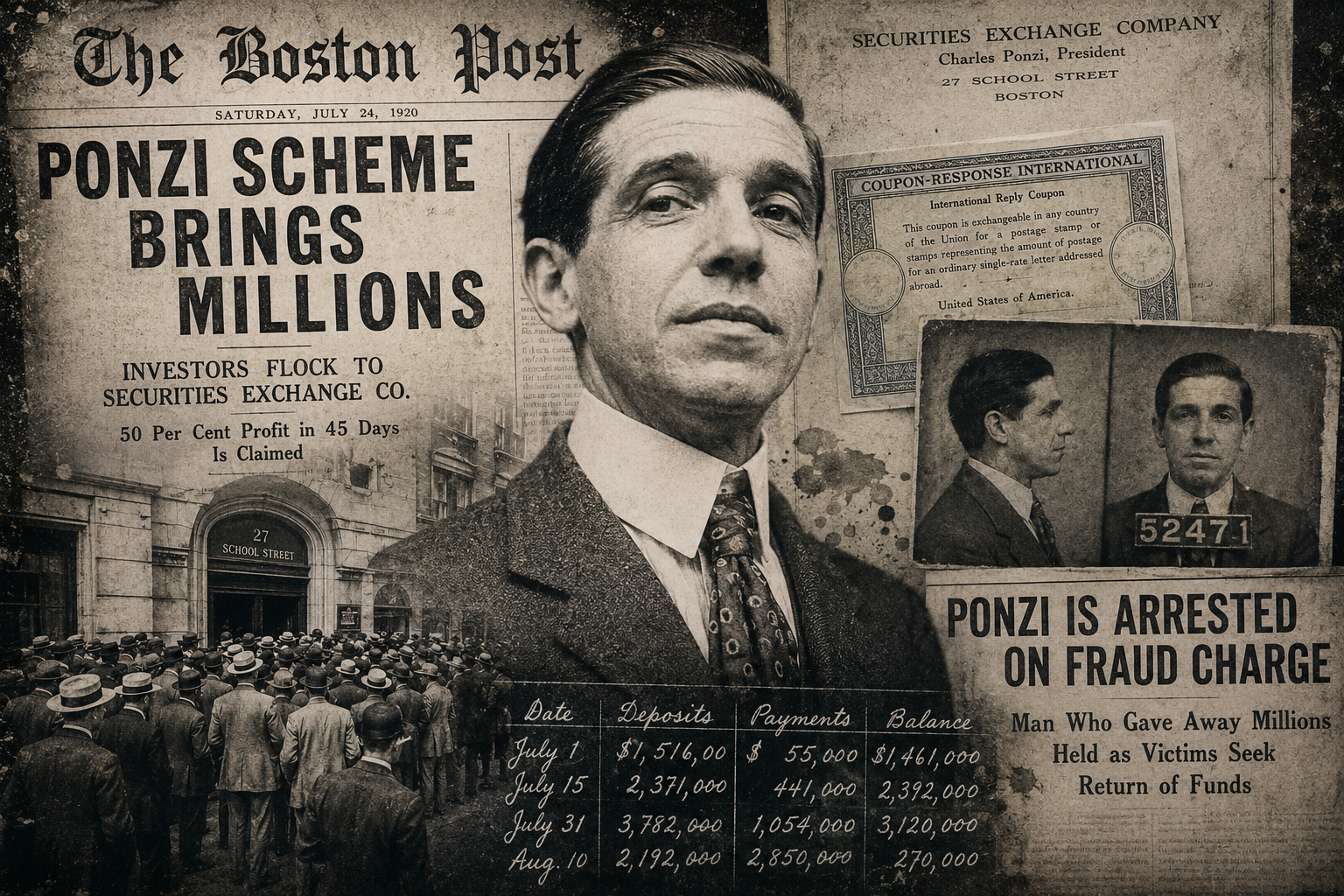
There is a line outside 27 School Street.
Then around the corner.
Then down the street.
Then all the way toward City Hall.
People are standing four abreast in the summer heat. Some have cash in their hands. Others are holding the little notes that say Charles Ponzi owes them money.
A lot of money.
Inside the building, Ponzi is trying to keep the whole thing from exploding.
Some people have come to invest.
Others have come because they’ve heard rumors and want their money back.
Ponzi doesn’t hide.
He does the opposite.
He comes outside.
He talks to the crowd.
He orders coffee and sandwiches for the people waiting. Women are moved toward the front after some reportedly faint in the heat.
And then he does the one thing that makes absolutely no sense if you’re running a scam and thousands of frightened investors suddenly show up demanding their money.
He pays them.
One after another.
You want your money?
Here.
Next.
You too?
Here.
Next.
And something strange begins to happen.
People who came to withdraw their money watch other people getting paid and decide maybe they don’t want it back after all.
Some leave their money with Ponzi.
Some invest more.
Ponzi is surviving a bank run by paying everyone who asks.
And every person who gets paid becomes proof that Charles Ponzi is not a fraud.
Which is unfortunate.
Because Charles Ponzi is absolutely a fraud.
A little piece of paper
About a year earlier, Ponzi had received a letter from Spain.
Inside was something most people would have thrown in a drawer and forgotten about.
An international postal reply coupon.
The idea behind these things was actually pretty clever.
Imagine you’re living in Spain in 1919 and you send a letter to someone in Boston. You’d like them to write back, but you don’t want the American recipient to have to pay for the return postage.
You can’t exactly put an American stamp in the envelope.
So you buy an international reply coupon.
The person in Boston can take that coupon to the post office and exchange it for postage.
Simple.
But World War I had screwed up European currencies.
And Ponzi noticed something interesting.
A coupon purchased using a weakened European currency could, at least theoretically, be exchanged in the United States for postage worth more than what the coupon had cost.
Buy cheap over there.
Redeem for more over here.
Arbitrage.
Ponzi did some calculations.
And he became convinced there was money in it.
Potentially a lot of money.
There was only one problem.
He didn’t have any.
So he needed investors.
50 percent in 45 days
Ponzi created the Securities Exchange Company.
The name sounded impressive.
The offer sounded even better.
Give Charles Ponzi your money and he would return it in 45 days with 50 percent profit.
Or wait 90 days and double it.
Put in $1,000.
Get back $1,500.
In a month and a half.
Ponzi explained that the profits came from buying enormous quantities of international postal reply coupons overseas and exploiting the differences in currency values.
And here’s the important part.
The underlying idea wasn’t complete nonsense.
There really were international reply coupons.
There really were currency discrepancies.
There really was a theoretical arbitrage opportunity.
That was enough truth to carry a much bigger lie.
Because Ponzi wasn’t making his investors rich by trading millions of postal coupons around the world.
He was making his investors rich with money from his other investors.
The first people gave Ponzi money.
Then more people gave Ponzi money.
When the first group came back for their promised profit, Ponzi took some of the new money and paid them.
And they walked away with exactly what he’d promised.
Imagine you’re one of them.
You give this little Italian guy in Boston $1,000.
Your wife thinks you’ve lost your mind.
Your friends tell you it’s a scam.
Forty-five days later, you walk back into Ponzi’s office.
And he gives you $1,500.
Who’s the idiot now?
So you tell your brother.
Your brother tells someone at work.
That guy tells his neighbor.
And you?
You might put the $1,500 straight back in.
Ponzi didn’t need advertising.
He had something much better.
People who had actually been paid.
And then it went fucking crazy
Money started pouring in.
Not Wall Street money.
Regular people’s money.
Immigrants.
Shopkeepers.
Workers.
Police officers.
People handed Ponzi their savings.
Some reportedly mortgaged their homes.
His operation grew so quickly that money was being stuffed wherever employees could put it.
Drawers.
File cabinets.
Wastebaskets.
Ponzi had arrived in America in 1903 with almost nothing.
Now he was rich.
Really rich.
He bought a mansion in Lexington.
Cars.
Fine clothes.
A custom limousine.
He bought properties.
He acquired interests in businesses.
And eventually he took control of Hanover Trust, the same Boston bank that had previously refused to lend him money.
That must have felt good.
The newspapers began writing about him.
And that made things even crazier.
On July 24, 1920, the Boston Post put Ponzi on its front page.
The headline told readers that this man was paying 50 percent interest in 45 days.
Thousands more wanted in.
At the height of the frenzy, enormous amounts of money were arriving every day.
Charles Ponzi had somehow become one of the most talked-about financial men in Boston.
There was just one tiny problem.
The postal coupons.
Where the hell were all the postal coupons?
Someone finally did the math
Clarence Barron was a financial journalist.
His name might sound familiar.
Barron’s.
That Barron.
And Barron looked at Ponzi’s business and asked a boring question.
How many postal reply coupons would you actually need to generate these returns?
The answer was ridiculous.
Roughly 160 million coupons would have been needed to support the scale of business Ponzi was claiming.
There were only about 27,000 circulating worldwide.
Not 27 million.
Twenty-seven thousand.
The math wasn’t a little off.
The entire premise was impossible at Ponzi’s scale.
There was something else Barron noticed.
Ponzi wasn’t investing his own money in this miraculous machine that supposedly generated 50 percent every 45 days.
Think about that.
If you had genuinely discovered a virtually guaranteed way to turn $100 into $150 every month and a half, what would you do with every dollar you personally owned?
Exactly.
Ponzi wasn’t doing that.
The Boston Post started digging.
And the story got worse.
Much worse.
Charles had neglected to mention Canada
Before Charles Ponzi became Boston’s financial genius, he’d spent time in prison.
In Canada.
For forgery.
In 1908, under the name Charles Bianchi, Ponzi had forged a check.
He went to prison.
After getting out, he managed to get himself arrested again, this time for helping smuggle Italian immigrants across the Canadian border into the United States.
That earned him time in a federal prison in Atlanta.
None of this was particularly helpful information when your entire business depended on people trusting you with their life savings.
On August 11, 1920, the Boston Post published the story.
They even had his old mugshots.
The financial wizard of Boston was a convicted forger and former federal prisoner.
Now the crowd outside 27 School Street looked different.
The money wasn’t there
Government auditor Edwin Pride had been examining Ponzi’s books.
On August 12, he delivered the answer everyone was waiting for.
Ponzi was insolvent.
Badly.
Initial estimates put him about $3 million in the hole. That figure was later revised much higher.
And investigators found almost nothing resembling the giant international postal operation Ponzi had described.
A later accounting found just $61 worth of postal reply coupons among the company’s assets.
Millions of dollars had passed through his hands.
Sixty-one dollars in coupons.
There was no secret international network generating fantastic profits.
There was money coming in.
And money going out.
That was basically it.
New investors paid old investors.
Old investors told everyone how brilliant Ponzi was.
Those people became new investors.
Their money paid the next group.
And as long as more money entered than left, Charles Ponzi could keep performing the miracle.
Until he couldn’t.
On August 12, 1920, Charles Ponzi was arrested.
Eight months.
That was roughly how long it took him to go from another broke guy with an idea to one of the most famous financial operators in America.
And then to jail.
But Charles Ponzi wasn’t finished
He pleaded guilty to federal mail fraud and went to prison.
Then came state charges.
More prison.
And somehow, between court cases and appeals, Ponzi got himself out on bail.
So naturally he went to Florida and started another scheme.
This time it involved land.
He created a company called the Charpon Land Syndicate and sold investors tiny parcels of Florida property while making grand claims about what their investments could become.
It ended exactly how you would expect.
More fraud charges.
More running.
More prison.
Eventually Massachusetts got him back.
When Ponzi finally finished serving his sentences in 1934, the United States deported him.
He had lived in America for more than 30 years.
He had never become an American citizen.
So Charles Ponzi went back to Italy.
The world moved on.
Eventually, he ended up in Brazil, where he worked for an Italian airline until the Second World War helped put an end to that job too.
The man who once had thousands of people lining the streets of Boston begging him to take their money spent his final years scraping together a living teaching languages and doing translation work.
His health deteriorated.
His eyesight failed.
A stroke left him partially paralyzed.
On January 18, 1949, Charles Ponzi died in a charity hospital in Rio de Janeiro.
He left about $75.
Charles Ponzi did not invent the scam that bears his name.
People had run versions of it before him.
People have run much bigger versions since.
But nobody had ever put on quite a show as Charles Ponzi did in Boston in 1920.
For its investigation exposing him, the Boston Post won the 1921 Pulitzer Prize for Public Service.
Ponzi got something even more permanent.
His name became the scam.
A century later, you don’t need to know who Charles Ponzi was.
You don’t need to know about Boston.
You don’t need to know about international postal reply coupons.
You don’t even need to know what he did.
Someone just has to tell you:
It’s a Ponzi scheme.
And you know exactly what they mean.